概要
Conversational analytics in the enterprise means translating plain-language questions into executable database queries, so answers come directly from structured data platforms without writing code or building a dashboard first.
Generative models made parsing the question straightforward. The operational hurdle moved somewhere less obvious: verifying the answer. On complex enterprise schemas, ungrounded text-to-SQL fails by generating incorrect joins, and published benchmarks put deployment accuracy anywhere between 50% and 70% on a raw schema and above 90% when queries compile through a governed semantic layer. The variation between deployments of the same technology is wider than the variation between technologies.
Conversational analytics defined
Conversational analytics is an interface layer, not a calculation engine. The aggregations, filters, and joins executed in the database remain standard SQL; what changes is who can run them and how quickly an answer arrives. Instead of filing a ticket with a central data team, a user states an intention in plain language and receives a verified result. It sits inside the broader adoption of AI across the analytics lifecycle, at the point where a human states what they want to know.
The value is not in replacing dashboards that track known measures. It is in answering the ad-hoc, multi-step questions dashboards were never built to anticipate—a sudden margin drop, a supplier exception, a one-off cohort comparison—which in most organizations is where the analyst queue comes from.
Two core modalities in the enterprise
Conversational AI spans consumer and technical domains. In enterprise analytics, deployment splits primarily into two modalities with different data, different buyers, and different failure modes.
Querying structured business data (text-to-SQL)
Natural-language access to structured data held in platforms, lakehouses, and warehouses. Business leaders ask operational questions—regional revenue shifts, inventory turnover, quarterly variance—and the system compiles them into database queries. These are the questions business intelligence has always answered. This guide addresses this modality.
Analyzing unstructured customer interactions
Analysis of conversational data itself—contact-center transcripts, chat logs, emails—to extract sentiment, intent, and operational friction. It depends on speech-to-text, language comprehension, and vector text mining rather than query generation. Analyzing customer conversations at scale is a substantial topic in its own right and is treated separately. Evaluating the two requires entirely different architectural criteria.
How conversational analytics works
Converting a human question into a mathematically sound database query takes four steps. Most of the difference between platforms sits in the second.
Intent parsing and entity extraction
Foundation models parse the prompt, isolating measures such as net revenue, dimensions such as sales region, and time constraints such as one quarter against the same quarter last year. Language variation is handled well—this is the step current models are good at.
Query generation and semantic compilation
The extracted intent is compiled into executable code. Basic systems generate SQL directly against raw column names, inferring how tables connect. Advanced architecture is compiled through a governed semantic layer where metric definitions, join paths, and business rules are certified in advance. The distinction sounds technical and is the single largest determinant of whether the answer is correct—the mechanics of querying data in natural language depend on this step to prevent hallucinated logic.
Multi-turn context retention
Real analysis is iterative: the second question refines the first, the third narrows again. Context retention preserves prior filters, state variables, and aggregation levels so a follow-up does not require restating everything—without it, users return to the analyst queue they were trying to bypass.
Result presentation and query auditing
Returned payloads become charts, summary tables, or text. Crucially, enterprise platforms display the compiled SQL alongside the visual, so an analyst can audit the exact logic that produced the output. Turning results into visuals is well understood; showing the work is what determines whether analysts trust it.
Why accuracy varies so widely
Operational reliability depends on the structural metadata available to the system rather than on the raw capability of the model behind it.
|
Evaluation environment |
Baseline/ungrounded |
Governed/modeled |
Source and test details |
|
Unmodeled baseline dataset |
64.5% overall text-to-SQL |
72.7% semantic layer |
dbt Labs ACME Insurance benchmark, April 2026—11 questions, 20 runs, 15 tables |
|
Fully modeled data |
90.0% (Claude Sonnet 4.6)/84.1% (GPT-5.3 Codex) |
98.2% (Claude Sonnet 4.6)/100% (GPT-5.3 Codex) |
dbt Labs ACME Insurance benchmark, April 2026. Modeling quality improves both direct SQL and semantic execution. |
|
Complex enterprise schemas |
— |
76.13% |
BIRD benchmark, single trained model track. Vendor-reported. |
How data modeling and semantic layers impact results
Models do not intrinsically know how an organization defines its terms. They cannot infer a custom fiscal calendar offset, a net-versus-gross revenue exclusion, or a correct join path that nobody wrote down. A semantic layer is the translation fabric between the question and the schema: it defines each metric once, storing certified calculation logic, table relationships, and row-level access policy. The model maps intent onto those definitions rather than guessing at database logic. Grounding in business context is what ensures asking the same question returns the same number across every business unit.
The implication for buyers is useful. If the semantic groundwork has not been done, no product in this category will perform the way its demonstration did—because the demonstration ran against modelled data.
Failure modes to evaluate
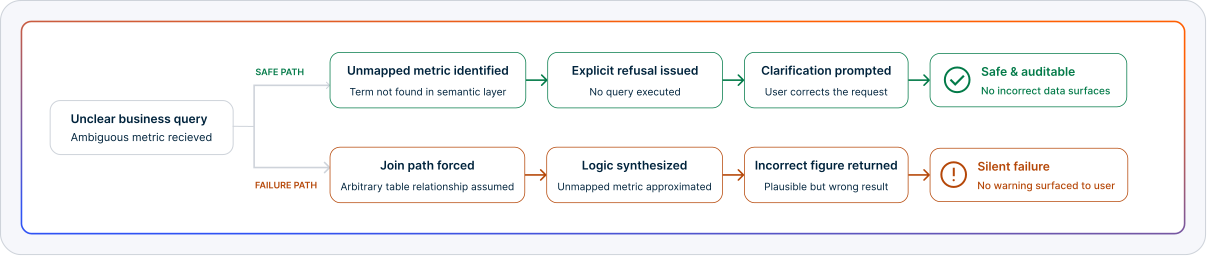
Ungrounded engines fail silently. They force a plausible join path, assume a missing filter value, and return a confident, correctly formatted number that is wrong. Nobody knows how to check it. In a board pack, that number becomes a decision. Practitioners raise this consistently, and it is why experienced analytics teams are more cautious about this category than the marketing suggests: the barrier to asking a question has dropped, and the barrier to interpreting an answer has not.
Real-world enterprise use cases
Self-service executive and business reporting
Leaders pull period-over-period growth or regional margin change without joining an analyst queue.
Implementation requirement: Centralized metric definitions, so two executives asking the same question receive the same number.
Financial variance decomposition
Finance interrogates line-item variance during close, isolating whether an overrun came from volume, price, or currency.
Implementation requirement: Certified account hierarchies and period-close flags held in the metadata layer.
Operations and supply chain exception monitoring
Logistics traces bottlenecks across multi-region supplier networks and identifies affected inventory the moment an exception fires.
Implementation requirement: High-concurrency query processing and current operational data.
Customer cohort and marketing analysis
Marketing sizes cohorts and measures lifetime value across custom attributes without dedicated engineering support.
Implementation requirement: Reliable identity resolution across CRM and billing tables.
Benefits and governance dependencies
Decision latency falls because the multi-day loop through a reporting queue disappears. Data engineers are released from retrieval work toward modelling and platform governance. More decisions get made on evidence rather than instinct, which is the outcome decision intelligence has been pursuing for years.
Each benefit carries the same dependency. Natural-language interfaces make asking easy; centralized semantic management is what makes the answers trustworthy. The value arrives only where business meaning has been captured in the data layer rather than held in the heads of the people who used to answer the questions.
What to evaluate in enterprise conversational analytics software
Demonstrations in this category are unusually persuasive because they run against data modeled for the demonstration. Seven questions separate what a product shows from what it will do on an enterprise estate.
|
Requirement |
Stress test to ask in the demo |
Why it decides the outcome |
|
Centralized metric governance |
Where do metric definitions live—in prompt templates or a semantic layer? |
Prompt-level definitions cause metric drift between business units. Logic has to be centralized. |
|
Deterministic failure handling |
What happens when a query names an unmapped metric? |
The system must decline or clarify. A silent hallucination inside a financial report is unmonitored risk. |
|
SQL auditability |
Can an analyst view, debug, and copy the generated SQL? |
Analysts will not trust results they cannot inspect, and regulated reporting cannot use them. |
|
Database-level entitlements |
Does the query execute under the user's database role or a service account? |
If the interface bypasses the access model, it has created a governance problem, not solved an access one. |
|
Federated execution |
Can the engine query across hybrid and multi-cloud estates without moving data? |
Most platforms in this category query one warehouse. Everything else needs federation or replication. |
|
Unstructured data access |
Can it join relational tables with vector-embedded transcripts and logs? |
A growing share of enterprise questions touch content that never enters a table. |
|
Unified control plane |
Are models, semantic definitions, and telemetry managed together? |
Platforms that manage all of these together—like Teradata AI Studio—answer several of these questions from a single place. |
Where this is heading: Agentic analytics and open protocols
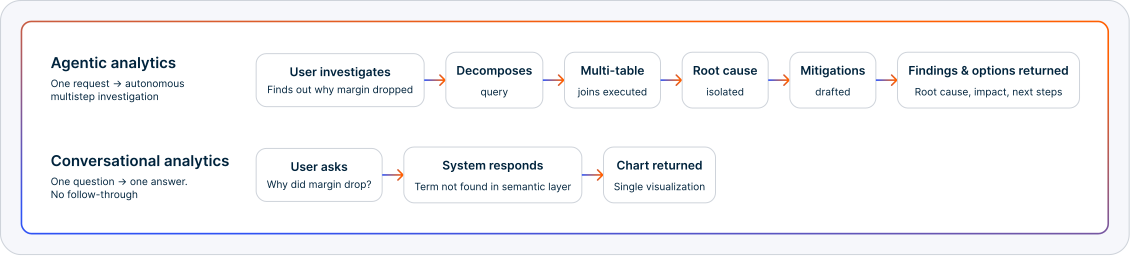
Conversational analytics answers a prompt. Agentic AI carries out a task—planning a sequence, running several queries, evaluating results, and deciding what to do next. Applied to analytics, this means a system that investigates rather than responds. AI agents in business intelligence are the near-term form of that.
Autonomy changes what integration has to provide. Open interfaces such as the Model Context Protocol standardizes communication between agents and external tools; enterprise implementations such as Teradata Enterprise MCP add authentication, authorization, and role-based access control on top of it. Orchestration layers such as Teradata Enterprise AgentStack supply the telemetry and safety boundaries that make deployment against production data defensible, and multi-agent systems sharpen the point further—attribution becomes genuinely hard once several agents contribute to one outcome.
Conclusion
Conversational analytics changes how enterprise teams reach their data, but success depends far more on semantic grounding than on interface design. Whether it works in each organization is a question about that organization's data: whether metrics are defined once, whether permissions hold wherever the data is reached, and whether the system says so when it does not know. Platforms that ground natural-language queries in certified business logic—such as Tera running on Teradata Cloud—reach the same conclusion the benchmarks do: the interface is the easy part, and the meaning underneath it is not.
To evaluate governed conversational analytics against your own metric definitions and access model rather than a demonstration dataset, talk to us.
Frequently asked questions
What is the difference between conversational analytics and conversational AI?
Conversational AI is the broad field of systems that hold a dialogue—virtual assistants, contact-center bots. Conversational analytics is the narrower application of that capability to data: the questions concern metrics, trends and segments, and the answer is produced by querying a data source rather than retrieving a scripted response.
Does conversational analytics replace dashboards?
No. Dashboards remain the most efficient way to monitor a fixed set of measures many people watch. Conversational analytics complements them by handling the ad-hoc, multi-step questions a dashboard was never built to anticipate.
Do users still need to understand the data?
Yes, and this is the most common misreading of the category. These tools lower the barrier to asking a question without lowering the barrier to interpreting the answer. Someone still has to know whether the number means what it appears to mean, which is why business context in the data layer matters more than conversational polish in the interface.
How is conversational analytics different from agentic analytics?
Conversational analytics answers a question. Agentic analytics carries out a task: it plans a sequence of steps, runs several queries, evaluates what comes back, and decides what to do next. The distinction is between a system that responds and one that acts, and it changes what governance the deployment needs.