
Agents don’t pause—and the business won’t either. As they move from pilots into core workflows, they create continuous demand, bursty spikes, and high concurrency. Many platforms break here: performance becomes inconsistent, costs become unpredictable, and operations teams end up tuning by hand.
The Autonomous Knowledge Platform is built for flexible scalability, with active and elastic compute that keep price-performance predictable. In an agent-driven environment, the platform must make continuous placement and sizing decisions where work runs, including how much compute it gets, how concurrency is shaped, and how performance and cost are optimized in real time. This is agentic management, built by the same experts who made Teradata synonymous with best-in-class workload management and query optimization.
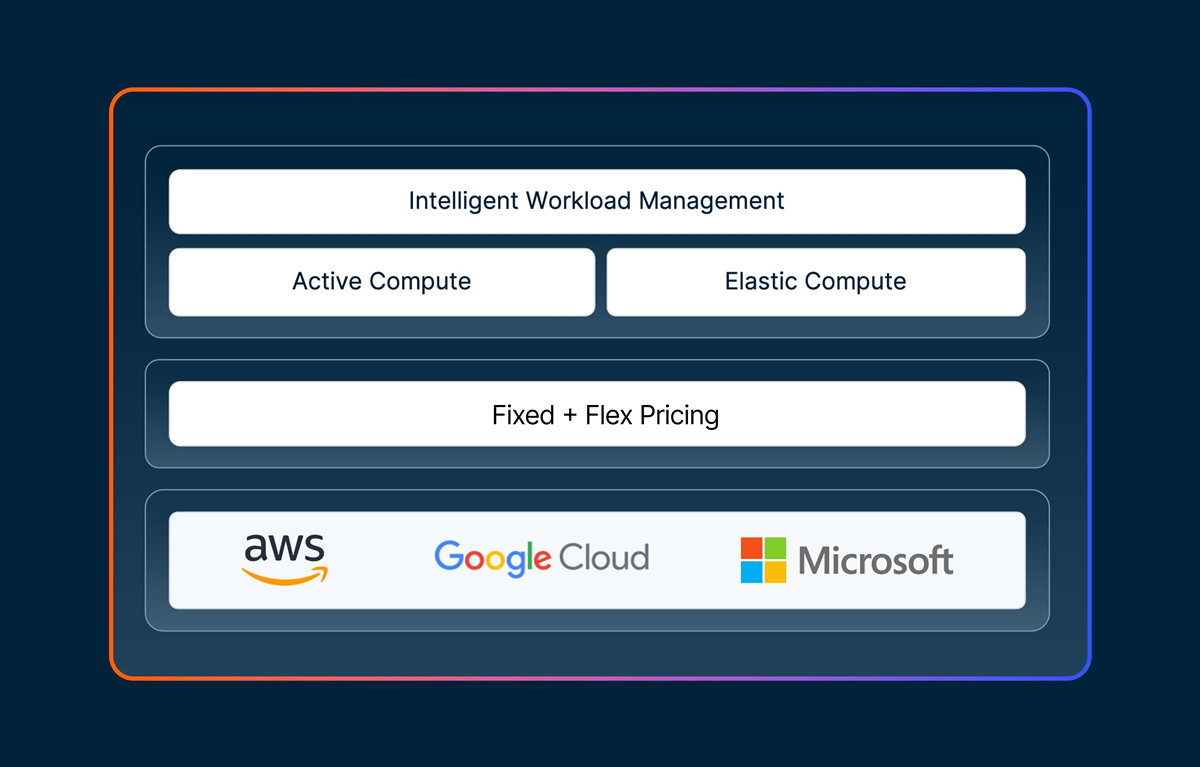
Agentic management senses demand and continuously routes, sizes, and tunes workloads across active and elastic compute, protecting service-level agreements (SLAs) while optimizing price-performance:
- Prioritize and protect: Keep mission-critical, governed agent workflows predictable
- Route and right-size: Place each workload on the right compute profile, and scale it with demand and without permanent overprovisioning
- Optimize continuously: Keep execution efficient and unit economics in check as usage scales
High-performance OTF: Modern access without modern headaches
Always-on intelligence depends on fast, reliable access to data across formats and storage systems. Open table formats (OTFs) improve interoperability with formats like Iceberg and Delta Lake—but only if performance holds under real concurrency and repeated access patterns.
High-performance OTF in the Autonomous Knowledge Platform makes open access practical at scale—strong execution speed, predictable behavior, and consistent governance—so teams don’t trade trust or performance for flexibility.
Predictable economics: Fixed + Flex leveraging unit pricing
When agents scale, consumption gets spiky, and getting to the true cost versus business value of the workload becomes even more problematic. At Teradata, we understand that our clients are focused on cost versus business outcomes. Teradata’s unit pricing provides measurable usage—supporting forecasting, FinOps discipline, and return on investment (ROI) clarity as workloads expand. Teradata leverages a Fixed + Flex model aligned to the economics of how enterprises operate:
- Fixed covers steady, always-on needs so you can plan and operate with confidence
- Flex absorbs variable demand so you can handle spikes without paying for idle capacity
What this unlocks is simple: always-on outcomes without always-on overhead—continuous intelligence that stays performant, governed, and financially predictable as demand swings.
In my next post, I’ll return to the builder experience—how Tera gives teams one place to build, activate, and govern AI outcomes end to end.